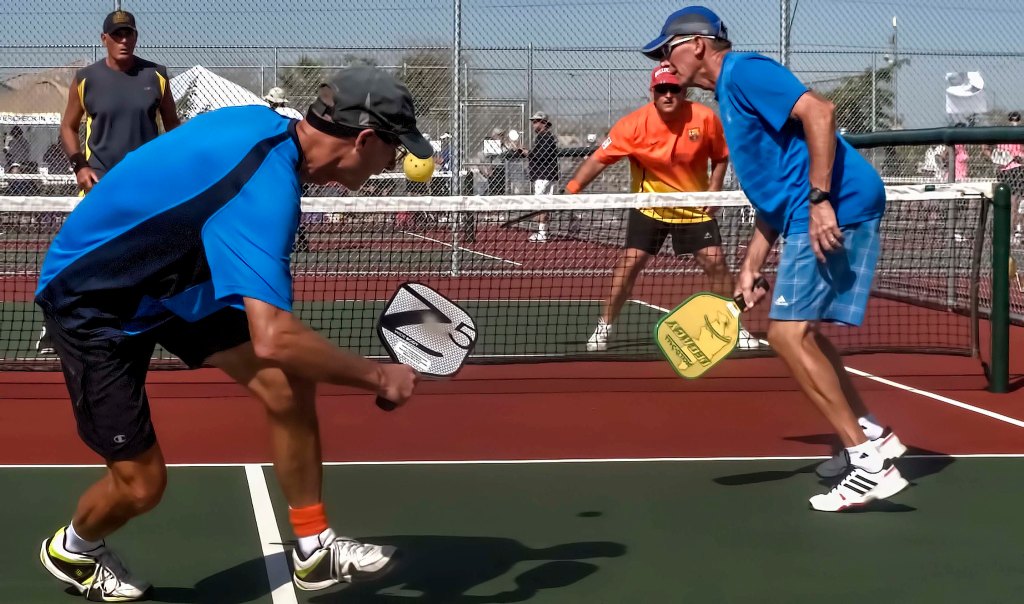
In a lifetime of covering sports that took in Wimbledon, the Olympic Games and Champions League finals I never heard ‘get out of the kitchen’ or ‘nice dink’.
But then I only discovered Pickleball recently when I went to Cobham Village Hall in Surrey to try a sport that blends tennis, badminton and table tennis and is growing fast in the UK.
It was invented near Seattle in 1965 by friends improvising ways to invigorate children lazing around all summer. Because the equipment was made from odds and ends it reminded them of the rowing term ‘pickle boats’, those with oarsmen picked from the discards of other crews. No, me neither.
Holiday makers to the USA brought the game back with them to England around 2011. A decade on there are an estimated 4,000 players in England playing in leisure centres and schools or outdoor on tennis courts marked up for Pickleball.
The sport is played as singles or doubles, in- or outdoors, on a badminton-sized court with a much lower net. It has a paddle-style bat and a wiffle ball with 26–40 round holes. The aim is simple – serve underarm like badminton, get the ball over the net and stop your opponent hitting it back – but the rules are more complicated.
The ‘kitchen’ refers to the no-volley zone either side of the net where much of the action takes place and a ‘dink’ is a soft, subtle shot. Points are usually won by manoeuvring opponents with strategy rather than powering through them.
This emphasis on placement makes it suitable for all genders and ages and the size of the playing area is ideal for those over-50s like me who are no longer able to cover a tennis court.
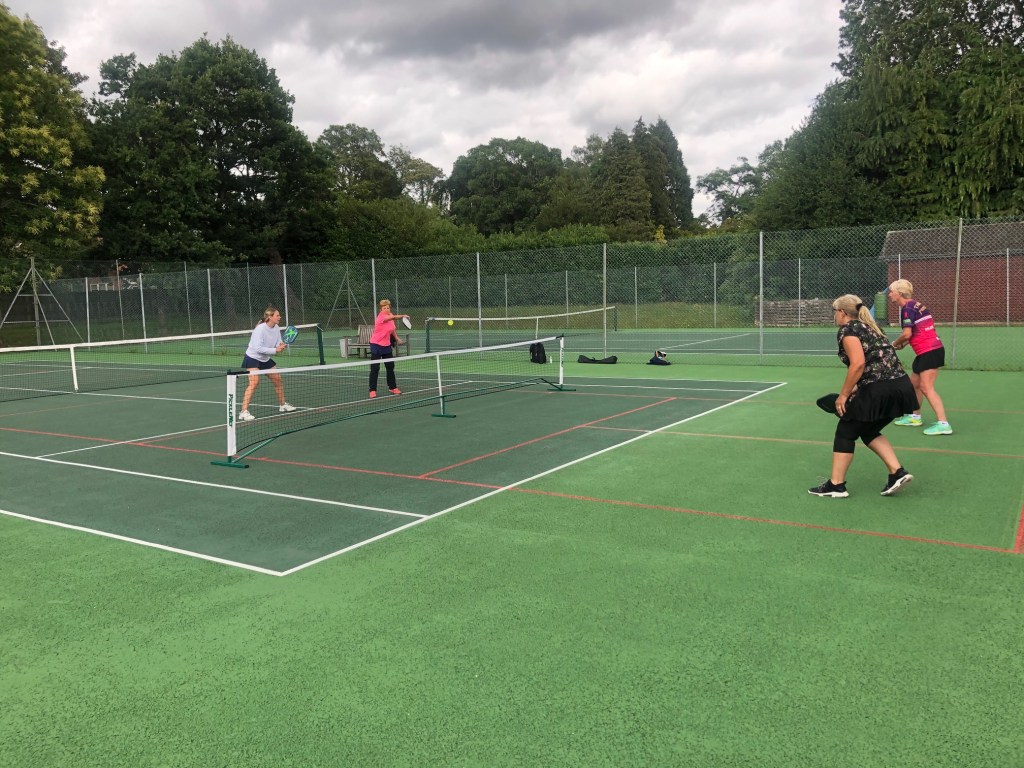
The best way to learn is to have a go and pick the rules up as you go along. Matches are played to the first to 11 points so they are over pretty quickly, allowing players to catch their breath.
Playing under informal ‘Cobham Rules’, which uses more aspects of tennis that classical Pickleball does, I picked it up fast. I worked up a sweat dashing from baseline to kitchen and gave the ball a whack as well as doing plenty of dinking. Indeed, a fine overhead volley would have won the match only for Ray, my doubles partner, to tell me sorrowfully that I was in that blasted kitchen.
Ray tried the game while living in the United States and brought back the equipment to the UK but had nowhere to play until the Cobham club started up a few years ago. He said, “We now run two sessions a week here, set up a satellite club in Walton a year ago with four courts and have a qualified coach. It’s so popular that membership is closed.”
Nigel runs the club with Ray. He has Parkinson’s Disease and finds Pickleball ideal mental and physical exercise.
“Injuries mean I can’t play bowls or walking football any more but I need to keep body and brain active. Pickleball rules say play for pleasure rather than for being full on competitive so we have a proper game but it’s still friendly and sociable.”
Andy Homewood is another who tried the sport in the United States. Now a qualified Pickleball coach, he has space for newcomers at his West and South Surrey Pickle Ballers (WASSPS) sessions in Guildford and New Haw if players book. The age range is late 30s to mid 70s with a 50/50 gender split.
He’s had people become regular players after walking over to ask what was going on.
“People see it is an excellent follow on from tennis or squash as it is gentler on joints and muscles. Psychologically, it is great for people who think their racquet playing days may be over.”
 Dom the Rambler
Leave a comment